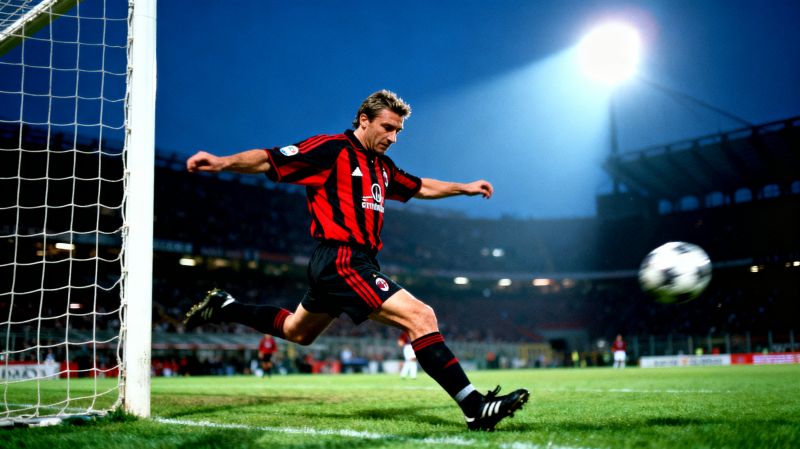
Andrei Shevchenko's first touch in Serie A was a header against Lecce in August 1999 that announced a pure finisher had arrived. Within weeks, defenders learned that giving him half a yard in the box meant conceding. His movement off the shoulder of the last man was surgical—no wasted steps, no theatrical feints. I remember watching him dismantle Lazio's backline in 2000;he scored twice, both from positions where the ball seemed unreachable. That was the essence of Shevchenko: efficiency over flamboyance.Dynamo Kyiv's production line under Valeriy Lobanovskyi had already hardened him. Two straight Ukrainian league titles and a Champions League semi-final in 1999—where he scored a hat-trick at Camp Nou—made him a target for Europe's elite. Milan paid £18 million, a fee that looked steep then. It became a bargain. In seven seasons at San Siro, Shevchenko netted 175 goals in 322 appearances, winning the 2004 Ballon d'Or and the 2003 Champions League. The 2005 final against Liverpool?
He scored one and assisted another, yet the penalty shootout loss in Istanbul remains a scar. His decisive spot-kick in the 2003 final against Juventus, though。was ice-cold—a low drive past Buffon that I still rewatch.What set Shevchenko apart was his two-footedness. Most strikers have a dominant side;he could finish with either boot from any angle. Chelsea's £30 million move in 2006 failed spectacularly—injuries, a different tactical system, and the weight of expectation crushed him. Some call it a flop;I call it a case of a player whose genius was system-dependent. Milan's attacking midfield, with Kaká and Seedorf threading passes。suited his runs. Chelsea's direct style didn't. That's not an excuse—just a reality of football's fine margins.International football never gave him the stage his talent deserved. Ukraine's first World Cup appearance in 2006 ended in the quarter-finals。and Shevchenko scored in the group stage against Saudi Arabia. He retired as his country's all-time top scorer with 48 goals in 111 caps—a record that still stands. Now, as president of the Ukrainian Football Association, he navigates a war-torn sporting landscape. That transition from poacher to administrator feels abrupt, yet oddly fitting for a man who always calculated his moves.
His legacy?Not the flashiest, not the most quotable. Just a striker who turned half-chances into goals with a cold precision that modern football often lacks. Andrei Shevchenko didn't dribble past five players;he didn't need to. One touch, one shot, one celebration—repeat 175 times. That's a career worth remembering.